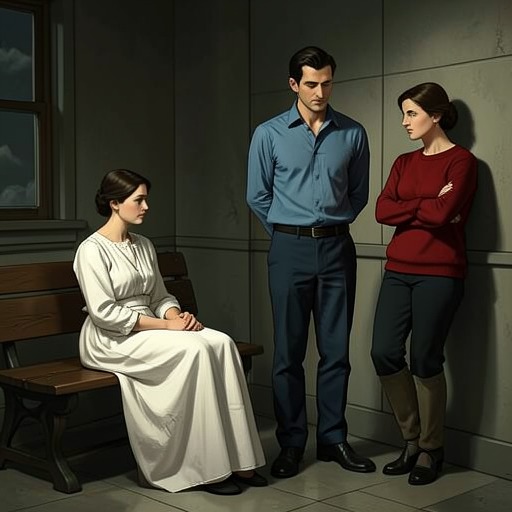
Ben Howard
The Woman in Cabin 10Ben Howard is Laura Blacklock’s former colleague at Velocity and her former partner, a figure whose return aboard the Aurora Borealis complicates both her personal history and the investigation surrounding the cabin 10 incident. Introduced through Laura’s startled recognition, he moves from apparently intrusive ex-boyfriend to wounded intermediary and finally to the person who raises the alarm when her disappearance is ignored. His trajectory exposes how quickly Laura’s fear, guilt, and the ship’s atmosphere of secrecy can turn an imperfect ally into a suspected accomplice.
Identity and Reappearance
Ben re-enters Laura’s life at the ship’s formal gathering, where she is shocked to find him grinning through a thick hipster beard that has appeared since their last meeting. She introduces him to Cole Lederer by explaining that they used to work together at Velocity, while Ben’s current employment is uncertain enough for her to hesitate over the name of the publication. His presence therefore carries two kinds of awkwardness: he belongs to Laura’s professional past, but he is also a reminder of a relationship she has deliberately left behind.
His manner is teasing and socially observant. He apologizes while defending his curiosity as his own business, complains that his collar is tight, tugs at his bow tie, and asks Laura how she managed to secure the assignment, framing the invitation as evidence that she is going up in the world. He also comments dryly on the evening’s most conspicuous woman, Anne Bullmer, before asking Laura whether she is still with the Yank, meaning Judah Lewis. The questions are familiar rather than neutral, and their familiarity makes the encounter feel like an intrusion into a life Laura has rebuilt without him.
The Former Relationship and Its Unease
Laura makes the history explicit when another passenger remarks that she and the attractive Ben seemed friendly the previous night. Laura answers firmly that they were together years earlier and that she has no desire to return to that relationship. The statement establishes a boundary, but the surrounding circumstances show that the past is not emotionally inert. Ben’s reappearance coincides with Laura’s anxiety, the suspected disappearance from Cabin 10, and the breakdown of her confidence in the people around her.
Their contact is repeatedly physical in ways that sharpen the discomfort without restoring intimacy. When Laura is moving through the ship, Ben’s slurred voice reaches her from behind and his shadow falls across a doorway. Later, after an encounter that leaves her distressed, he crouches beside her on her cabin bed, puts one arm around her shoulders, and holds a tumbler of ice against his crotch. The gesture records both his drunken vulnerability and Laura’s reluctant dependence on him in a moment of crisis; it does not erase the history that makes his care difficult for her to receive.
Their movements across the ship continue to produce collisions. Laura walks into a bleary-eyed Ben, and later she literally runs into him in the aft-cabin corridor with enough force to knock the breath out of her. These repeated encounters give their relationship a pattern of involuntary recontact: Laura cannot simply place the past behind her because the enclosed cruise ship keeps returning Ben to her path.
From Familiar Ally to Suspect
As Laura tries to understand the missing woman and the possible murder, Ben becomes one of the men she weighs against her increasingly elaborate suspicions. He tells her that she should go and see Richard Bullmer, advice that can be read either as practical guidance or as an attempt to direct her toward the ship’s owner. Later, when Laura has begun to identify Richard as the man most capable of planning and carrying out a murder, she also considers whether Ben might be involved.
That suspicion is intensified by Laura’s own unstable circumstances. She knows that Ben knows her well enough to recognize that an unexplained early-morning departure for Trondheim would be out of character. Under ordinary conditions, she thinks, he would have contacted Judah or her parents if he was worried. Yet she has left matters between them badly: she has effectively accused him of complicity in murder, and she imagines that his anger, along with the strangeness of her disappearance, might explain why he has not acted. The reasoning shows Laura trying to interpret silence as evidence while recognizing that her damaged relationship with Ben has distorted the ordinary channels of trust.
The turning point comes when Laura realizes that she has judged him too quickly. She had been so absorbed by Anne’s mention of a male accomplice that she failed to consider that Anne herself might have written the warning found in the spa. Once that possibility emerges, Laura feels guilt for having treated Ben as a likely criminal. Her self-reproach is part of the novel’s broader pattern of unreliable interpretation: fear makes every familiar person potentially threatening, while genuine danger remains concealed behind stronger social performances.
The Disappearance and the Public Narrative
Ben’s concern also enters the story through the public discussion of Laura’s disappearance. On the Whodunnit forum, anonymous participants refer to Laura incorrectly, speculate that her medication indicates instability or suicidal intent, and treat Judah’s absence from the country as material for suspicion. Judah responds that Laura takes medication for anxiety rather than depression, rejects the automatic association between medication and instability, and insists that the recovered body has not been identified as Laura. Ben is not the speaker in this exchange, but the forum’s hostile speculation supplies the climate in which his own concern is later judged.
A later report further confuses the case by describing Lord Bullmer’s death as non-self-inflicted and mentioning a gun wrapped in clothing belonging to Laura. Because Laura has been missing, the report initially connects Bullmer’s death to her disappearance, while also stating that she is eventually found alive in Norway. The communication failures surrounding the body leave Laura’s parents believing for days that their daughter has been identified as dead. In this environment, Ben’s actions must be understood against a public narrative that repeatedly converts incomplete evidence into confident stories about Laura, her mental health, and the people closest to her.
Alarm, Reassessment, and Narrative Role
After Laura is rescued and returns to England, she sees that Ben left no message among the calls recorded for her. She feels a stab of guilt and is surprised that he is speaking to her at all, since she had more or less accused him of being behind everything. Judah then reveals the decisive fact: Ben was the person who raised the alarm. Calling from Bergen to ask whether Laura had made it home safely, Ben learned that Judah had not heard from her since Sunday and urged him to contact the British police because the matter was urgent. Ben had been raising hell since Trondheim, but no one among the Aurora Borealis crew would listen to him.
This revelation reverses Ben’s apparent function in the plot. He is not the hidden accomplice Laura feared but a neglected witness whose knowledge of her habits makes him recognize that her disappearance is abnormal. His earlier anger and his history with Laura do not make him wholly comfortable or uncomplicated; they make his persistence more credible, because he continues to act despite being distrusted and despite the fractured state of their relationship.
Ben therefore occupies the narrative position of the misread ally. His beard, drunkenness, awkward jokes, sexual history with Laura, and tense encounters make him easy to classify as a threat, while his actual contribution is quiet and practical: he notices that Laura has not returned, presses for action, and refuses to accept the crew’s indifference. His arc turns suspicion into remorse and estrangement into reluctant recognition. By the end, Laura must confront not only the crimes committed aboard the ship but also the damage done by her own fear: the person she briefly imagined as part of the conspiracy was one of the people trying to bring her home.